

Teacher Resources
Hyde Park Barracks Virtual Site Study | Stage 2 (Years 3–4)
This virtual site study helps teachers deliver engaging, inquiry-based History learning aligned with the NSW HSIE K–6 Syllabus (2024).
Students explore life in colonial Sydney through four virtual stops, examining convict sleeping conditions, archaeological discoveries, daily routines, and changes to Hyde Park Barracks over time.
The resource works as a standalone classroom or remote learning experience, following a before, during, and after-excursion structure.
Central Inquiry Question: What can Hyde Park Barracks reveal about life in colonial Sydney?
Structured Learning Sequence
This virtual site study follows a three-part learning sequence to develop students’ historical inquiry skills.
Before your visit: Activate prior knowledge, introduce Hyde Park Barracks, and explore the central inquiry question.
During your visit: Guide students through four interactive investigations with historical photographs, archaeological artefacts, convict daily life, and changes over time.
After your visit: Students use evidence collected during the excursion to create a mini museum exhibition and answer the central inquiry question.
Teachers can deliver the activities across several lessons or adapt the sequence to suit their class.
Structured learning sequence
This virtual site study uses a structured before, during, and after learning sequence for Stage 2 students. The activities build historical inquiry skills by examining authentic sources, investigating convict life, and sharing their understanding of history.

1. Prepare and investigate
Before Your Visit:
Activate students’ prior knowledge of colonial Sydney, introduce the historical significance of Hyde Park Barracks, and discuss the central inquiry question. Students complete a See–Think–Wonder activity and explore key historical vocabulary.

2. Explore the Barracks
During Your Visit:
Guide students through four virtual investigation stops: convict sleeping quarters, archaeological discoveries, daily life as a convict, and changes to Hyde Park Barracks over time. Students examine historical sources and write their discoveries in their History Detective Journal.

3. Reflect and create
After Your Visit:
Students use three historical sources from their investigation to create a mini museum exhibition. They explain what each source shows about colonial Sydney and answer the central inquiry question using historical evidence. Students finish by reflecting on their discoveries.
Curriculum alignment and teaching support
This virtual site study helps Stage 2 students learn History through the NSW HSIE K–6 Syllabus (2024). Students build historical inquiry skills by examining primary sources, interpreting archaeological evidence, and investigating life in colonial Sydney.
Teachers can use these resources to support inquiry-based learning, adapt activities, and assess students’ understanding of the past.
Printable History Detective Journal
The History Detective Journal guides students through four virtual investigation stops at Hyde Park Barracks.
Students record observations in the convict sleeping quarters, investigate archaeological artefacts, create an evidence-based convict diary, and compare the Barracks over time.
The journal also supports the final mini museum exhibition, where students use historical sources to answer the main inquiry question.
Syllabus Alignment
NSW HSIE K–6 Syllabus (2024) - Stage: Stage 2 (Years 3–4) - Learning Area: History
Relevant Outcome: HS2-HIS-01
Students investigate life in the Sydney Cove penal settlement using historical sources as evidence.
Historical Inquiry Skills:
- Examining historical photographs, objects and written records.
- Identifying changes and continuities over time.
- Drawing conclusions about past experiences using evidence.
- Communicating historical understanding through creative and written responses.
Central Inquiry Question: What can Hyde Park Barracks reveal about life in colonial Sydney?
Teaching and Learning Pedagogy
This virtual site study uses inquiry-based learning to help students investigate the past using historical evidence. Students look at photographs, archaeological artefacts, and museum resources to build their understanding of life in colonial Sydney.
The activities reflect constructivist learning principles, where students develop understanding through exploration and discussion. Scaffolding, such as visual prompts, sentence starters, and the History Detective Journal, supports students with different learning needs.
Students build literacy through historical vocabulary, source analysis, and diary writing. Students develop numeracy by placing historical events on a timeline, while they build ICT skills by navigating digital museum resources.
Classroom and remote learning integration
Students can complete this virtual site study as a whole-class activity, in small groups, or independently.
Teachers can display historical sources on an interactive whiteboard and lead class discussions, while students working independently can explore the four investigation stops at their own pace.
Students write their findings in the History Detective Journal and use this evidence to complete their final mini museum exhibition. Teachers can adapt activities to support different learning needs and classroom settings.


Differentiation and Inclusive Learning
Learning Support:
- Offer vocabulary banks, visual prompts, and sentence starters.
- Allow students to record responses as drawings, oral explanations, or short written answers.
- Use teacher-led discussions and mixed-ability partnerships.
Extension:
- Encourage students to compare several historical sources and consider different perspectives.
- Challenge students to explain what historical evidence can and cannot show.
- Ask students to explore how different groups' experiences at Hyde Park Barracks changed over time.
Assessment Opportunities
Assessment is woven throughout the virtual site study to track students’ historical understanding, inquiry skills, and ability to use evidence.
Diagnostic Assessment – Before Your Visit:
- Use the See–Think–Wonder activity to learn about students’ prior knowledge and any misconceptions about colonial Sydney.
- Discuss the central inquiry question to check students’ initial understanding.
Formative Assessment – During Your Visit:
- Observe students as they take part in historical source investigations and discussions.
- Review students’ observations, artefact analyses, convict diary entries, and then-and-now comparisons.
- Give feedback on how well students make inferences supported by historical evidence.
Summative Assessment – After Your Visit
- Review students’ mini museum exhibitions using three historical sources.
- Evaluate how students explain what each source shows about colonial Sydney.
- Assess their final response to the central inquiry question, supported by at least two pieces of historical evidence.
Assessment Criteria
- Understanding and knowledge of the past.
- Interpreting and using historical sources.
- Identifying change and continuity.
- Communicating evidence-based historical explanations.

Ai Cover Sheet:
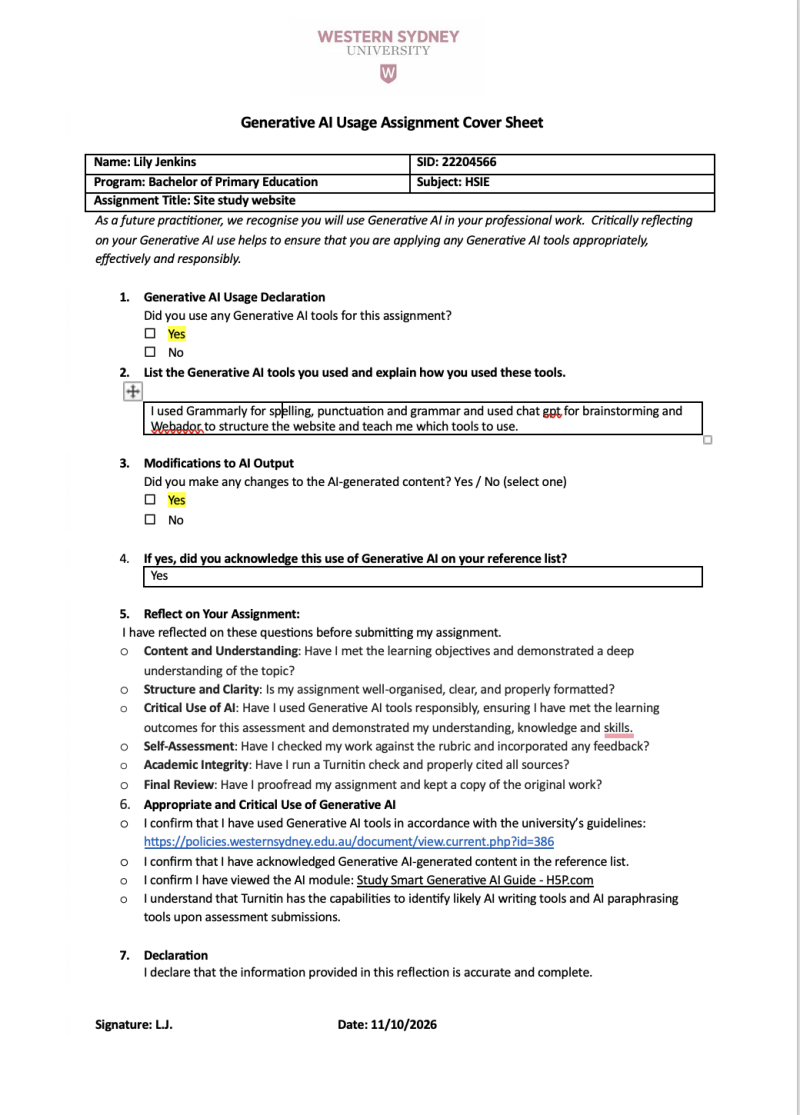
Referencing:
- Grammarly, Inc. (n.d.). Grammarly [Writing assistance software]. https://www.grammarly.com/
- Hyde Park Barracks, Sydney. (n.d.). In Wikipedia. Retrieved October 11, 2026, from https://en.wikipedia.org/wiki/Hyde_Park_Barracks,_Sydney
- Museums of History NSW. (n.d.-a). Convict work at the Barracks. https://mhnsw.au/learning/convict-work-barracks/
- Museums of History NSW. (n.d.-b). Draw a convict indent. https://mhnsw.au/stories/general/activity-draw-convict-indent/
- Museums of History NSW. (n.d.-c). Hyde Park Barracks. https://mhnsw.au/visit-us/hyde-park-barracks/
- Museums of History NSW. (n.d.-d). Object analysis. https://mhnsw.au/object-analysis/
- Museums of History NSW. (n.d.-e). Site study: Tightening the grip – Life in the convict system. https://mhnsw.au/learning/hpb-site-study-tightening-the-grip-life-in-the-convict-system/
- Museums of History NSW. (n.d.-f). Site study: Timeline – Introduction to the site. https://mhnsw.au/learning/hpb-site-study-timeline-introduction-to-the-site/
- Museums of History NSW. (2020, February 20). Hyde Park Barracks – the convict years. https://mhnsw.au/stories/general/hyde-park-barracks-the-convict-years/
- Museums of History NSW. (2020, July 16). A short history of the Hyde Park Barracks. https://mhnsw.au/stories/general/short-history-hyde-park-barracks/
- Museums of History NSW. (2021). Archaeology in action: Hyde Park Barracks. https://mhnsw.au/stories/general/archaeology-in-action-hyde-park-barracks/
- Museums of History NSW. (2023, March 7). Hammock scrap. https://mhnsw.au/stories/convict-sydney/hammock-scrap/
- NSW Department of Education. (n.d.). Risk management process and proforma.
- NSW Education Standards Authority. (2024). Human Society and its Environment K–6 syllabus (2024). https://curriculum.nsw.edu.au/learning-areas/hsie/hsie-k-6-2024
- NSW Government. (n.d.). Hyde Park Barracks. https://www.nsw.gov.au/visiting-and-exploring-nsw/locations-and-attractions/hyde-park-barracks
- OpenAI. (2026). ChatGPT [Large language model]. https://chatgpt.com/